The Collected Writings of Franz Liszt by Hall-Swadley Janita R.;
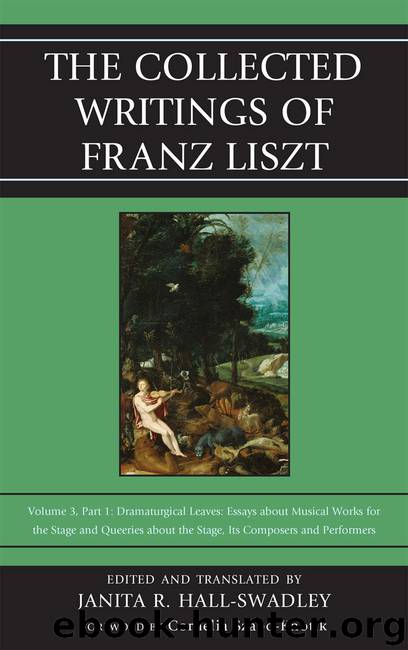
Author:Hall-Swadley, Janita R.;
Language: eng
Format: epub
ISBN: 9780810883307
Publisher: Rowman & Littlefield Publishers
Notes
** Translator’s Note: for narration purposes, Liszt’s “voice” will be printed in italics, Ramann’s “voice” will be printed in Courier New font, and my “voice” will be printed in standard Times Roman font. See pages 29-31 for more details.
618. Written after Liszt conducted the first performance of this work on 24 June at the Court Theater in Weimar. The editor. [This endnote was not in the earlier German edition.]
619. This article first appeared in Franz Liszt, “Schubert’s Alfons und Estrella,” Neue Zeitschrift für Musik 41/10 (1 September 1854): 101-5, hereafter referred to as NZfM1Sep54.
620. Liszt’s date is incorrect. Alfonso and Estrella was composed between 20 September 1821 and 27 February 1822, while Schubert and his librettist, Franz van Schober (1796-1882), collaborated on a “working vacation” in Upper Austria. See Robert Winter, et al., “Schubert, Franz,” Grove Music Online, Oxford Music Online, Oxford University Press, http://www.oxfordmusiconline.com/subscriber/article/grove/music/25109pg2 (accessed 3 December 2012), and Thomas A. Denny, “Schubert’s Operas: ‘The Judgment of History?’” in The Cambridge Companion to Schubert, ed. Christopher H. Gibbs (Cambridge and New York: Cambridge University Press, 1997), 230.
621. Alfonso and Estrella was not received well from the beginning. After submitting the work to the director of the court theater in Vienna (the Kärtnertortheater), which Schubert was invited to do, the opera was rejected. It took an additional thirty years before the opera was premiered by Liszt in 1854, perhaps at the behest of Schober, who was then serving as Liszt’s secretary. At this premiere, Schubert’s original overture was omitted, and a new overture, written by Anton Rubinstein (1829-94) replaced it. See Robert Winter, et al., “Schubert, Franz,” accessed 3 December 2012.
622. Instead of the phrase “after its creation,” NZfM1Sep54 contains the word “later.”
623. See endnote 167 on page 52 for general information about Schubert.
624. Instead of the words “poetry and tone” NZfM1Sep54 contains the words “tone poetry.”
625. Instead of the words “creation of works,” NZfM1Sep54 contains the words “their productions.”
626. The expression “Sturm und Drang,” which translates as “Storm and Stress,” describes a German literary movement that flourished in the 1770s, whose authors and their lifestyles challenged the conventions of what seemed to them to be a narrow-minded society. Johann Wolfgang von Goethe (1749-1832) was a leading figure of this movement in Weimar. The expression is also used metaphorically to suggest an exuberant and youthful reaction to something. It appears that Liszt is alluding to both references here. See David Hill, “Introduction,” in Literature of the Sturm und Drang, ed. David Hill, History of German Literature series, vol. 6 (Rochester: Camden House, 2003), 1-2.
627. The adjective “elaborate” appears before the noun “works” in NZfM1Sep54.
628. Liszt’s description about Schubert’s reclusiveness may be a bit misguided. It is now known that during his last years (from approximately April 1823) his physicians urged him to remain at home for fear of spreading syphilis, of which Schubert began showing symptoms beginning in January 1823. By this time, Schubert had become well known and respected in Viennese musical circles, and to hide his disease, he declined social invitations.
Download
This site does not store any files on its server. We only index and link to content provided by other sites. Please contact the content providers to delete copyright contents if any and email us, we'll remove relevant links or contents immediately.
The Great Music City by Andrea Baker(33662)
Aircraft Design of WWII: A Sketchbook by Lockheed Aircraft Corporation(32383)
Call Me by Your Name by André Aciman(20733)
The Secret History by Donna Tartt(19472)
The Art of Boudoir Photography: How to Create Stunning Photographs of Women by Christa Meola(18760)
Shoot Sexy by Ryan Armbrust(17853)
Plagued by Fire by Paul Hendrickson(17541)
Portrait Mastery in Black & White: Learn the Signature Style of a Legendary Photographer by Tim Kelly(17107)
Adobe Camera Raw For Digital Photographers Only by Rob Sheppard(17094)
Photographically Speaking: A Deeper Look at Creating Stronger Images (Eva Spring's Library) by David duChemin(16800)
Ready Player One by Cline Ernest(15146)
Pimp by Iceberg Slim(14800)
Bombshells: Glamour Girls of a Lifetime by Sullivan Steve(14220)
The Goal (Off-Campus #4) by Elle Kennedy(13965)
Art Nude Photography Explained: How to Photograph and Understand Great Art Nude Images by Simon Walden(13147)
Kathy Andrews Collection by Kathy Andrews(12093)
The Priory of the Orange Tree by Samantha Shannon(9363)
The remains of the day by Kazuo Ishiguro(9225)
Thirteen Reasons Why by Jay Asher(9122)
